

Applied Learning Programme ALP
Applied Learning Programme (ALP)
To strengthen the development of Emerging 21st Century Competencies (E21CC) among our students, the school has integrated our Learning for Life Programme (LLP) into our Applied Learning Programme (ALP) starting 2026.
The revised ALP, ‘TNPS Influencers for a Greener Tomorrow’, will combine the strengths of our LLP and ALP in the areas of language mastery, advocacy skills and environmental stewardship, allowing students to benefit from richer learning experiences as they champion meaningful causes.
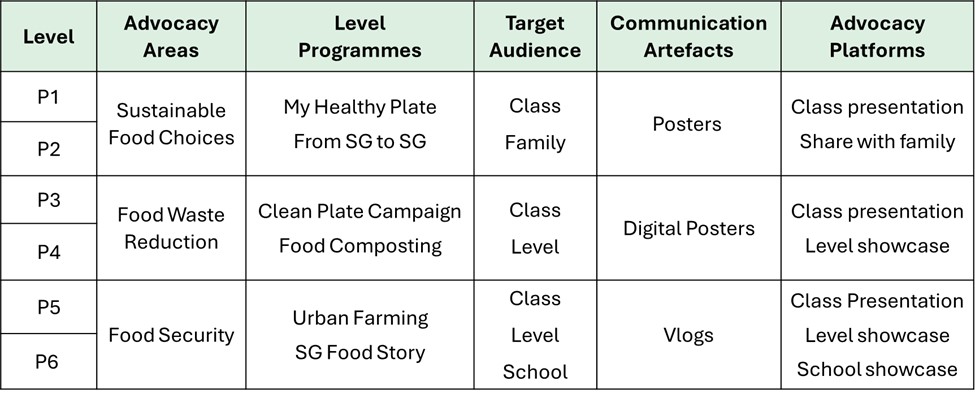
At the different levels, students will be presented with real-world environment issues to raise awareness and advocate for in their school and community. Students will collaborate in groups to explore the issue, create an artefact (such as posters and vlogs) which will be used as a communication tool to share their message about the issue to their audience.
To become effective advocates, students will be equipped with skills for critical research and creative content creation. They will also hone their communication skills to convey their message effectively, and develop the values and dispositions needed to positively influence others.
The real-world environmental issue focus for 2026 will be on food sustainability, which is one of the key areas of sustainability aligned to MOE’s Eco Stewardship Programme.
Interdisciplinary Project Work (IPW) will be adopted to provide a pedagogical framework to guide the implementation of the revised ALP. Through applied learning, students deepen their understanding and see relevance in what they learn by making connections between their learning and their lived experiences. Interdisciplinary learning helps students combine knowledge and skills from various subjects, allowing them to connect insights and build a deeper, more complete understanding of an issue. Students engage in inquiry-based learning as they make observations in the real-world context (examining different sources of information, asking questions, analysing and interpreting data, making conclusions and explanations) and propose solutions to address the issue. Collaborative learning allows students to develop responsibility for one another’s learning through joint inquiry, working together to achieve a common learning goal.
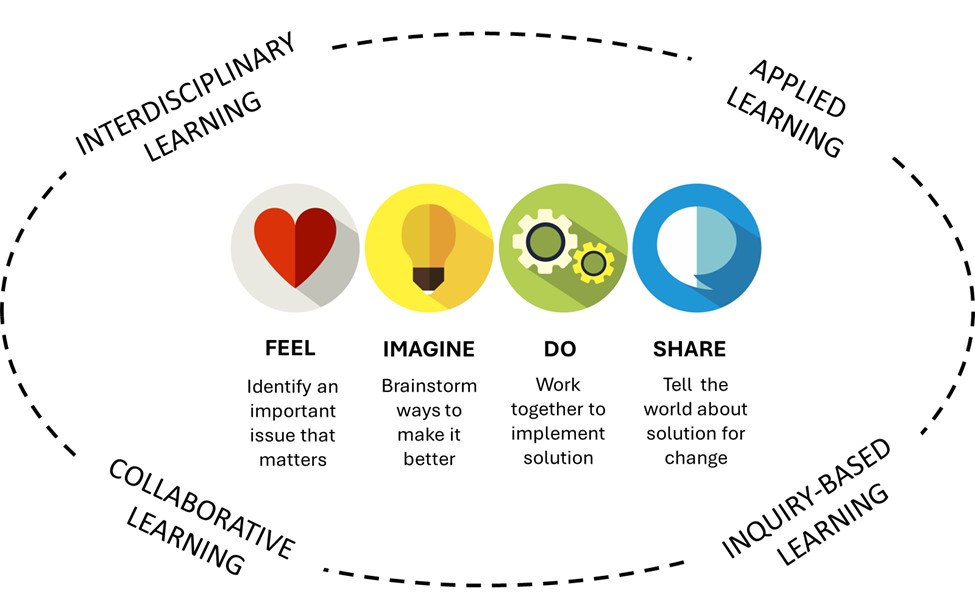
IPW will be piloted with Primary 3 in 2026 and it will be gradually rolled out to other levels.